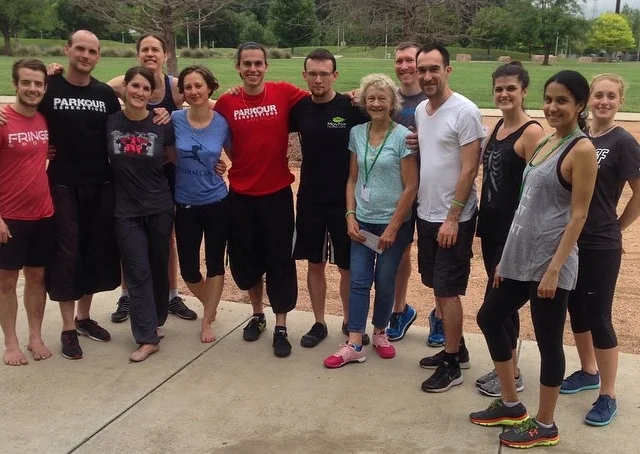
Last weekend, I traveled with Dan Edwardes (Managing Director of Parkour Generations, London) and Blake Evitt (Director of Parkour Generations Americas, Boston) to Austin, Texas to present and coach at Paleo f(x), a premiere conference for Paleolithic, natural, and ancestral lifestyle enthusiasts to connect and learn.
At the conference, Dan, Blake, and I hosted introductory parkour training sessions for attendees. Dan also presented on a panel that discussed training, athleticism, and the difficult retirement transition for professional athletes. The discussion highlighted the identity struggles that traditional sports athletes face after they reach their peak performance and can no longer be competitive. The direction of the presentation eventually lead to discussion of the intentional focus on longevity in parkour, about which Dan shared insight. He explained to the host, panelists, and attendees how proper parkour training allows practitioners to continue to improve over the course of their lives, even if their pure physical potential plateaus at mid-life. One of Dan’s major points was this: we must understand that peak performance is not just a matter of strength; it is a combination of physical ability and experience gained. With both factors considered, an athlete’s overall performance can continue to grow even if physical gains become limited by an aging body.